RNG isn't really all that "R"
|
I've noticed something odd with random number based rolls. Just now, I had two six-linked rare weapons drop in the same map. And in the 16+ days my character has been played this league, (Christ, I need to take a break!). I have seen a grand total of.... two six-linked weapon drops. Damned odd, that! And this isn't the first time I've noticed a sort of clumping of random drops. Last week, after several days of no exalts I had two drop in the same delving session.
I've seen similar things happen in other games too. Sure, it might be that random number generation is truly, utterly random and I only notice these events because they are outliers, and not because they are common. But it does make me wonder how the random number generation works. I went down the google rabbit hole of how random numbers are generated and all I have to show for it is a headache. But some of y'all may understand this shit well enough. So what gives? Is it possible that random number generation in games gives me a window of time where a roll is more likely as opposed to just that single split second? Or is there something influencing the likelihood of an event/drop/whatever per instance, rather than per loot drop? Any of you code-savvy folks have a theory on this? Knowledge is power. Power corrupts. Stay stupid. Last edited by Foogalicious#2739 on Jan 26, 2019, 6:56:00 PM Last bumped on Jan 26, 2019, 10:51:46 PM
|

|
|
Random is Random.
~ I play slowly.
|

|
|
In my case, RNG works in one way: you get the item or "chance" 2 TIMES maximum in few minutes or nothing for hours or days.
If I do a map with high item quantity or rarity, RNG "knows" that I want something good (exalt, unique specific drop or something similar) and if it drop 1 time, I've few minutes or seconds to get THAT SAME ITEM again. Same example with 6 link chance. Mirror is the only exception: dropped only 1 time in cruel ledge Sry guys, but it has been this way for me since I started playing this amazing game. It never failed. Last edited by Saituron#1011 on Jan 26, 2019, 7:36:01 PM
|

|
|
You will notice what ever pattern you're looking for. That's what random does to you.
|

|
|
Tell him professor educate him
XD Dys an sohm
Rohs an kyn Sahl djahs afah Mah morn narr |
|
|
This is exactly how random works. A common misconception about random sequences is that there cannot be repeating values, but that's simply not true.
You can try it yourself with dice... roll a die a couple hundred (or thousand) times, and you're very likely to see clumps of numbers. That doesn't mean the die rolls aren't random. Also, obligatory xkcd: https://xkcd.com/221/ 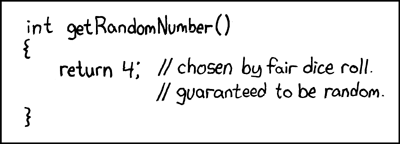 - here's my sig Last edited by AcrylicHercules#1220 on Jan 26, 2019, 8:21:01 PM
|

|
" In spite of my frequent proclamations to the contrary* I am not an idiot. I understand how random numbers are supposed to work, and a little bit about probability. And sure, if you are rolling a mere six-sided die, then the probability of rolling, say a six two times in a row is a mere 1/6 x 1/6 = 1/36. Not all that unlikely. But the probability of getting a six-linked rare weapon is orders of magnitude less likely than that. Let's be incredibly conservative and say it is 1/20,000. In that case, the odds of getting it 2 times in a row would be 1/20,000 x 1/20,000. Which is one in 400 million. Still think this sort of thing should be happening repeatedly? *viz, that I am indeed an idiot Knowledge is power. Power corrupts. Stay stupid. Last edited by Foogalicious#2739 on Jan 26, 2019, 8:54:00 PM
|
|
|
Usually the rand() function in C or C++ is a pseudo-random number generator with the srand() function used to generate the starting seed number for the rand() sequence. So if the starting seed number is the same then the random number sequence coming from it will always be the same.
I haven't done any C programming in years but a quick google search leads me to this: Random Number Generation. It appears that the old clock timer function of the original 8253 timer chip in the original IBM PC is still in use to generate the seed for the random number generators in C and C+++ using: srand(time(NULL)). It is possible that this may not be good enough to produce a truly random number if GGG doesn't use the above srand(time(NULL)) function to change the seed for the rand() function often enough. Programmers with up to date c++ skills can clarify (if they know) how GGG seeds the random number generator function. "You've got to grind, grind, grind at that grindstone..."
Necessity may be the mother of invention, but poor QoP in PoE is the father of frustration. The perfect solution to fix Trade Chat: www.pathofexile.com/forum/view-thread/2247070 |

|
|
The most common thing me and my friends noticed long ago - the currency you spent on crafting will be returned (part of it) to you from mobs right after you go mapping. Use exalt on item - take it right back from mobs.
P.S> don't blame me if it doesn't work ;) Last edited by aefoa#3559 on Jan 26, 2019, 9:35:50 PM
|

|
|
I am a software engineer and I have, in the past, looked into how random number generators work just out of academic curiosity. So I have a cursory understanding of how they work.
None of that really matters here though. The simple fact is that every major language has it's own built in random number generating function which is plenty close enough to being actually random that to a human it may as well be perfectly random. If you don't know what you are doing with them then sure you could screw it up and get not entirely random numbers from it, but it doesn't take a genius to do it right.The odds of that happening in a professional organization who stakes so much of their product on RNG is pretty much nonexistent. The simple fact of the matter is that this is the best answer: " |

|